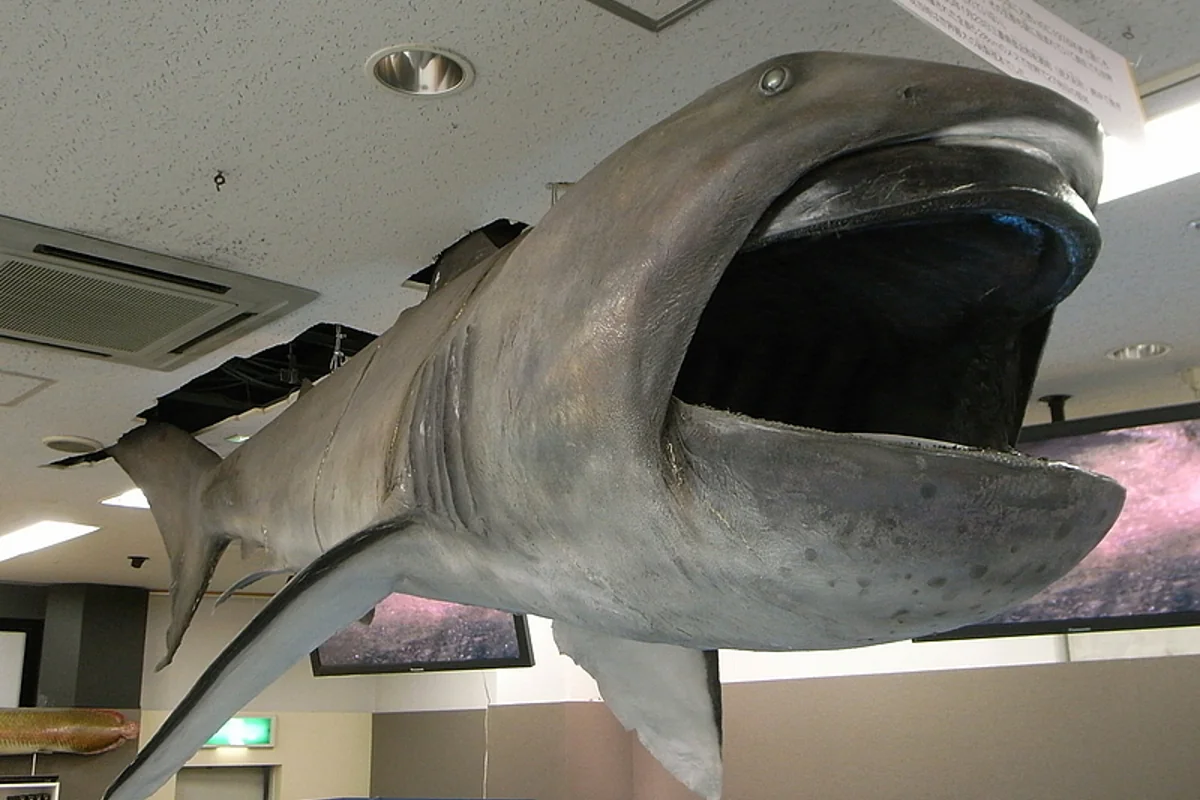
When was the megamouth shark discovered? The first scientifically recognized specimen was found on November 15, 1976, off Oʻahu, Hawaii. It became entangled in equipment deployed by a U.S. Navy research ship. Scientists formally described the species in 1983, naming it Megachasma pelagios. Those two dates explain why accounts sometimes appear to disagree: one marks the discovery, the other the published scientific description.
This is a Pacific marine-life story rather than a guide to an animal you should expect to see from a San Diego beach. Megamouths remain difficult to study, and an unusual shark sighting should not be identified from a vague impression of a large mouth.
What happened on November 15, 1976?
Hawaii's Department of Land and Natural Resources recounts a research ship working about 25 miles off Kahuku Point, the northern end of Oʻahu. The crew had deployed large parachute-like sea anchors into deep water. When the equipment came back up, a very large unfamiliar shark was entangled.
The animal did not survive. It was brought ashore for examination, where local marine biologists and shark specialists became involved. This was not a planned encounter with a known species. The appearance and anatomy presented researchers with an animal that did not fit the sharks they already recognized.
Why it was named megamouth
The enormous mouth made the informal name memorable. DLNR credits Waikiki Aquarium director Leighton Taylor among the scientists involved in the discovery and later naming. The eventual scientific name refers to a great open-sea mouth, fitting an animal whose feeding anatomy is central to its identity.
It was not merely a new local record of a familiar shark. The scientific description recognized a new species, genus and family. That distinction helps explain why the discovery attracted attention beyond Hawaii: a large marine vertebrate had remained outside scientific recognition until a chance encounter.
Why the scientific date is 1983
Finding an unfamiliar animal and formally describing it are different tasks. Anatomy must be examined, comparisons made and the work published. In the megamouth's case, DLNR describes a seven-year interval between the 1976 encounter and formal scientific description.
Use 1976 when answering the simple discovery question. Use 1983 when discussing the formal naming and description. Neither date proves that people had never encountered such a shark before; they describe the documented scientific record, not every possible observation in human history.
What do megamouth sharks eat?
Megamouths are plankton feeders. DLNR's account identifies euphausiid shrimp in the original specimen's diet, while the Smithsonian explains that megamouths filter small food such as krill from the water. They are one of three well-known filter-feeding shark groups, alongside whale sharks and basking sharks.
Similar diets do not make those sharks the same kind of animal or mean they feed in precisely the same way. The Smithsonian describes uncertainty about the megamouth's exact feeding mechanics. A large mouth and small prey are established parts of the story; a detailed scene of how an unseen animal feeds should not be presented as direct observation.
Are megamouth sharks friendly?
“Friendly” is not a useful scientific description of a rarely encountered wild shark. A plankton-feeding diet does not make an animal a pet or an invitation to touch it. The better answer is that its feeding biology is unlike that of sharks hunting large prey, while knowledge of its behavior remains limited.
Give any wild marine animal space. Do not approach, chase, feed or try to ride a shark because a travel page calls it gentle. If a large unfamiliar animal appears close to shore or stranded, follow lifeguard and wildlife-authority directions rather than trying to handle it.
Why scientists still have questions
The Smithsonian emphasizes that megamouths live offshore and likely spend substantial time in deeper water. Rare encounters make it hard to observe ordinary behavior directly. Reports and specimens can answer some questions while leaving others open, especially when the behavior involves an animal moving through the open ocean.
That is a good reason to avoid a fixed worldwide sighting count on an evergreen page. New records can change it, and not all reports offer the same quality of evidence. The Florida Museum's megamouth records are a better place to follow documented encounters.
What the discovery means for a coastal guide
Megamouth is a reminder that a familiar-looking ocean still contains poorly observed life. It is not a reason to expect a rare shark on an ordinary beach walk or to treat every large shadow as a discovery. Identification works best with clear photographs, context and expert review.
Explore the sharks guide for the broader topic, or choose a more observable coastal phenomenon with the grunion-run guide. In both cases, the most interesting account separates what is documented from what remains unknown.
Sources & further reading
Official information and references for this guide. Check the source for current access, rules and conditions.